France sees major street protests as schools and police tactics draw fire
Hundreds of thousands of citizens took to the streets nationwide this weekend, challenging the government over education funding and aggressive crowd control measures.
By Fatou Kim ·
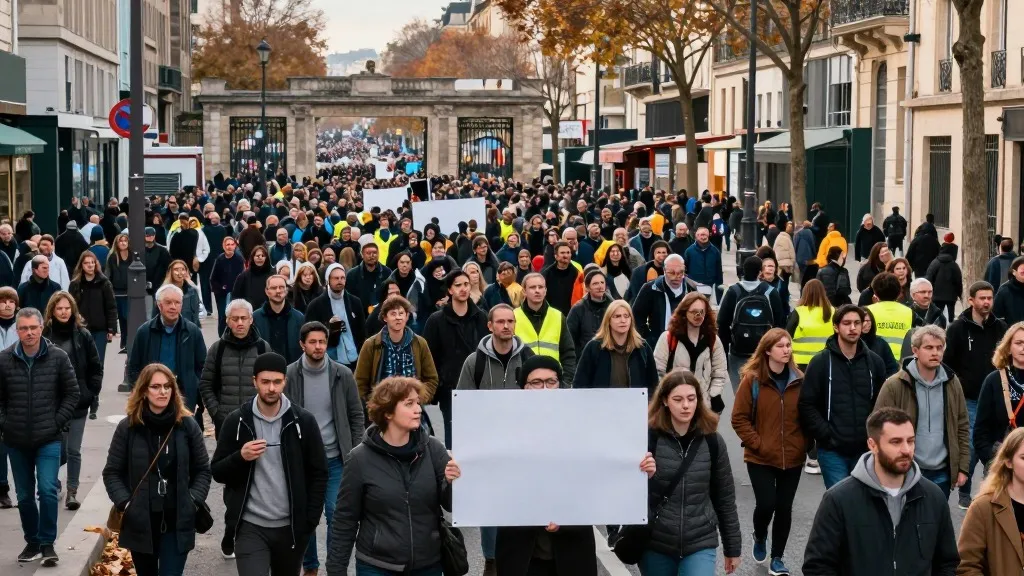
The French government calculated that at least 400,000 individuals participated in nationwide demonstrations this Saturday, a figure that trade unions argued was significantly underestimated. These marches, which occurred in major cities across the country, marked a significant escalation in the ongoing social unrest that has plagued President Emmanuel Macron during his final months in office. While the events were largely peaceful, they highlighted deepening divisions over the state of the education system and the manner in which authorities are managing public dissent.
In the capital, authorities reported that a minimum of 110,000 people marched along the eastern perimeter of Paris. The crowd included many supporters of the high school students who initiated the movement, but the discontent had broadened to include grievances regarding the rising cost of living. Many participants expressed frustration with what they perceived as overly forceful policing tactics. Instead of seeking political compromises, they argued, riot police had been deployed to target student protesters for the past month. Banners carried by marchers in Paris displayed slogans such as "Oppression breeds rebellion" and "The right to protest," underscoring the political nature of the gathering.
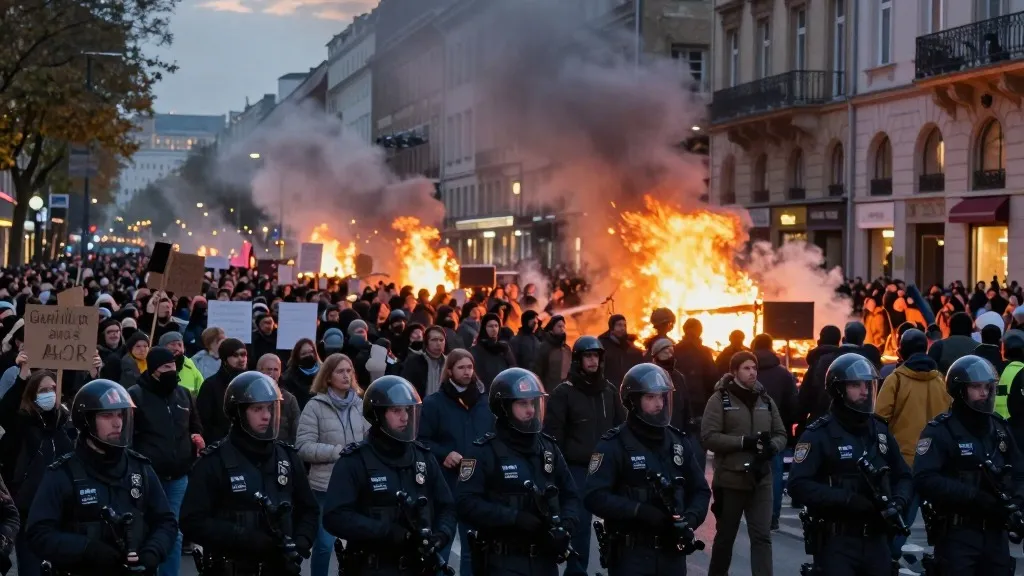
For much of the afternoon, the atmosphere in Paris remained calm, with brass bands providing music and families including children and grandchildren walking together. However, the tone shifted as the main route concluded near Porte de Vincennes on the city's eastern border. Groups of masked men dressed in black, who did not appear to be part of the primary peaceful crowd, began throwing glass bottles and stones at officers. Police responded with a combination of teargas, water cannon, and stun grenades. A trash bin was set on fire, and fireworks were launched toward the law enforcement lines. Similar scenes of tension unfolded in other major cities, where teargas was used in Lyon, Lille, Montpellier, Nantes, and Toulouse to prevent crowds from entering city centers. In Marseille, clashes also resulted in trash bins being burned.
The scale of the security operation was extensive, with over 70,000 police officers deployed to maintain order. In anticipation of the demonstrations, many local businesses boarded up their windows, and numerous museums closed their doors to the public. The government had braced for a repeat of the previous Saturday's events, which saw one of the most violent days of unrest in recent years. During that earlier incident, public buildings were burned, hundreds of shops were destroyed or looted, and at least 2,700 individuals were arrested, despite the protests initially being peaceful.
Criticism of the executive branch also focused on specific administrative decisions, such as the ban on non-union demonstrations deemed illegitimate by the state and the restriction keeping protesters away from central urban areas. Nadège, a 43-year-old communications worker who was teargassed during the previous weekend's events, stated that she returned to the streets to support those brave enough to demonstrate. She noted that fear was spreading among the public and affirmed that protesting in the streets is a legal right in France. A 21-year-old student from a science faculty currently blocked by demonstrators described the current situation as increasingly authoritarian, suggesting the regime was attempting to suppress the democratic right to protest.
The current crisis traces its origins to mid-September, when students aged 15 to 18 began protesting against staff shortages, crumbling infrastructure, and overcrowded classrooms lacking sufficient seating. The movement has since expanded into the largest youth-led initiative in years, attracting support from trade unions, teachers, and parents. Police investigations are currently underway following reports of children and protesters being injured or maimed by explosive police weaponry. Some demonstrators wore yellow vests, drawing a visual parallel to the 2018 and 2019 gilets jaunes protests.
Jérôme Rodrigues, a prominent figure from the 2018 movement, commented that the government's fear was evident in its strategy of pushing demonstrators to the city's edges, away from centers of power. He argued that police shields would not solve the economic struggles of the French people and predicted that demonstrations would continue every weekend. Pierre, a 60-year-old retired banking consultant, marched in support of his eight-year-old granddaughter, citing the government's refusal to listen to public demands. Jesse, a 40-year-old charity worker from northern Paris, noted that this was the first time she had prepared so meticulously for a peaceful march, wearing old clothes to protect herself from gas or tears in her clothing.
In Orléans, thousands of protesters marched against a congress hosted by Marine Le Pen's National Rally party. The crowd shouted anti-fascist slogans and chanted for Macron to resign and for Le Pen, a frontrunner in next year's presidential election, to be imprisoned. Both leaders are set to step down or face the electorate next year. Following the events, Interior Minister Laurent Nunez announced that 135 people had been arrested across France. He stated that various weapons had been confiscated, including metal balls, lead pellets, fireworks, slingshots, steel balls, improvised weapons, a katana sword, and airsoft weapons.