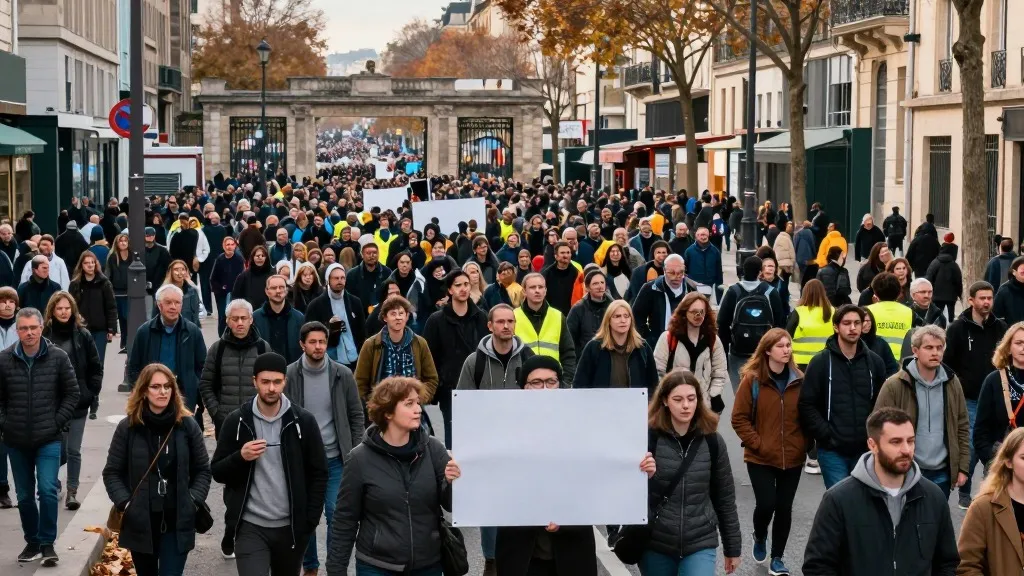
France Sees 410,000 Protesters in New Wave of Civil Unrest
A second wave of nationwide demonstrations in France ended with nearly 1,000 arrests as police worked to prevent a repeat of the severe disorder seen just days earlier.
By Olivia Miller ·
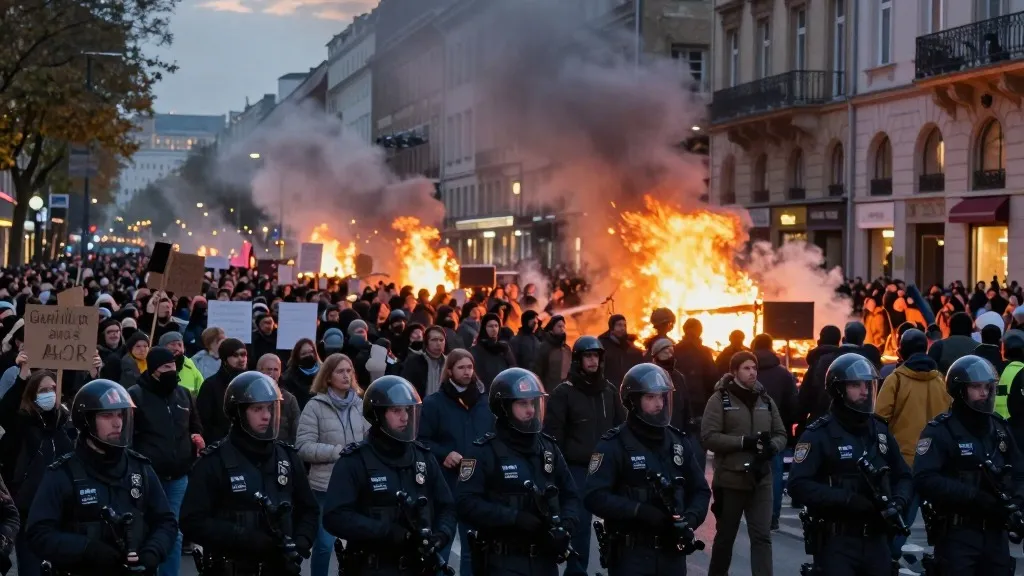
The interior ministry counted 410,000 people in the streets on Saturday, a figure that unions believe is significantly lower than their own estimate of 800,000. This fresh wave of nationwide protests marked a critical moment for French authorities, who were determined to prevent the chaos that had erupted only a week prior. While the day began with largely peaceful marches, the atmosphere shifted dramatically in the evening as clashes broke out in several major cities.
Security forces deployed approximately 70,000 police officers to manage the crowds and enforce new restrictions in key urban centers. The primary goal was to keep the demonstrations focused on cost of living and school conditions without allowing them to descend into the widespread rioting and looting that characterized the previous weekend. That earlier episode saw officers outnumbered, hundreds of businesses targeted, and buildings torched, creating some of the worst disorder in recent French history.
President Emmanuel Macron had issued a decree earlier in the week stipulating that only demonstrations organized by recognized trade unions would be permitted. This move was part of a broader strategy to control the narrative and the scale of the unrest. In the days following the initial protests, fast-track court hearings resulted in hundreds of individuals being jailed for vandalism, arson, and looting, signaling a stricter judicial approach to the ongoing civil friction.
In Paris, the trouble began after a peaceful march from Porte d'Italie toward Porte de Vincennes. Police operations in the capital involved an elite unit typically reserved for organized crime and counter-terrorism. Protesters constructed makeshift barricades and threw projectiles at officers, while police used batons to charge groups of masked youths who were smashing windows at a car dealership. Interior Minister Laurent Nuñez noted that several thousand radical activists gathered at the rear of the march, including around 500 individuals identified specifically as rioters.
Violence was not confined to the capital. In Marseille, demonstrators set fire to rubbish bins and used metal sheets to block streets. In Lyon, police fired tear gas to disperse a crowd that had gathered in an area the local prefecture had declared off-limits. One protester, part of a group of around 150 students, described the scene by saying, "You could barely see anything in the street." The use of water cannon and tear gas was a common sight across multiple cities as police sought to disperse the crowds.
By late in the day, Minister Nuñez confirmed that nearly 1,000 people had been arrested, with the figure expected to rise. He also reported that two people had been seriously injured, one in Toulouse and the other in Clermont-Ferrand. The demonstrations were accompanied by deep frustration among participants. A 26-year-old protester named Zelie told the BBC that people were "suffering a lot" and that "it's been too much." Two masked teenagers expressed a feeling of abandonment by the government, with one noting that while looting was "really not good," it was driven by poverty and police violence.
The unrest also sparked reactions beyond French borders. In Tirana, Albania, riot police fired tear gas at thousands of anti-government demonstrators, and clashes were reported in Brussels. In Milan, hundreds of soldiers and police prevented protesters from gathering, citing fears of a repeat of the previous week's violence. This international ripple effect underscored the growing tension across the region.
The current protests follow a massive demonstration last weekend that drew about 550,000 people against rising fuel prices and the cost of living. That event was preceded by weeks of student protests and resulted in more than 2,500 arrests. Over 2,000 shops and businesses were directly affected, with the Chambers of Commerce and Industry estimating damage in the hundreds of millions of euros. Approximately 1,000 police officers were injured, and one demonstrator lost a hand to a crowd-control grenade. With presidential elections six months away, leading political contenders have already begun to blame Macron and his ministers for the escalating situation.
In Orléans, some 13,000 people rallied peacefully against the hard-right National Rally party, showing that the opposition was not a monolith. The government now faces the challenge of balancing firm security measures with the need to address the underlying economic grievances that have fueled this sustained period of protest. The next few weeks will be crucial in determining whether France can stabilize before the electoral cycle intensifies the political stakes.