France Deploys 70,000 Officers to Guard Against New Wave of Unrest
A massive police presence surrounds fresh demonstrations in Paris as students and workers protest funding and rising costs following a volatile week of riots.
By Noor Phillips ·
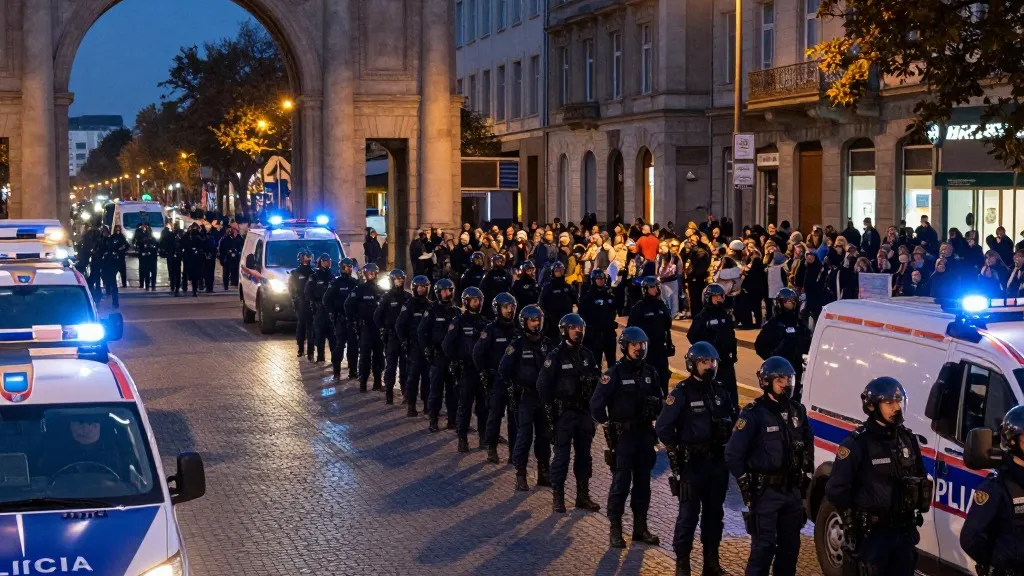
The tension in France reached a critical point on Saturday as the nation prepared for a new cycle of public demonstrations. This latest gathering arrives just seven days after widespread disorder saw commercial properties looted and vehicles set ablaze, leaving a lingering sense of fragility in major urban centers. The current mobilization represents a significant escalation in security measures, with authorities aiming to prevent a repeat of the recent chaos while allowing citizens to voice their grievances over educational funding and the escalating cost of living.
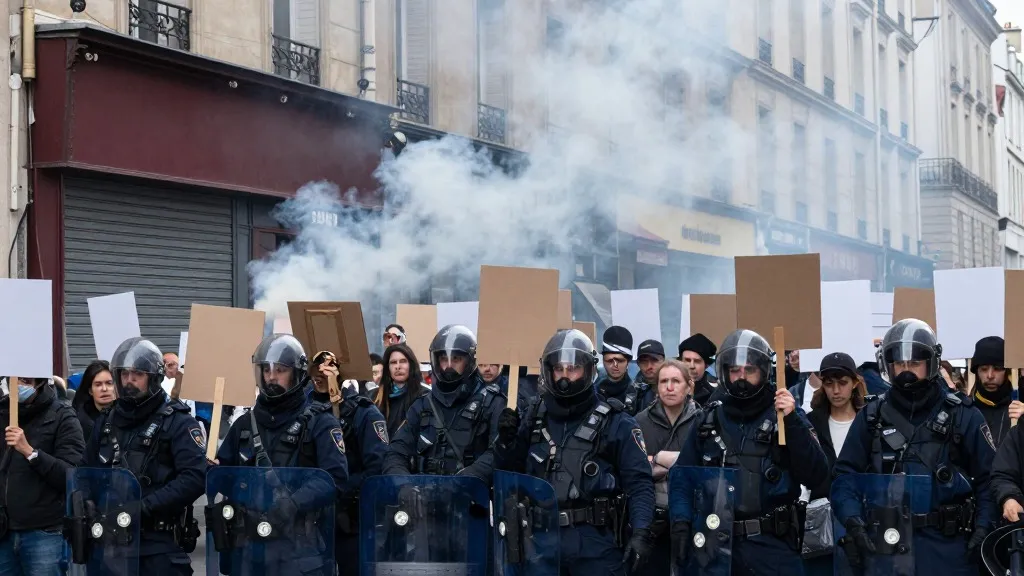
The scale of the security operation is unprecedented in recent months. Interior Minister Laurent Nuñez announced that as many as 70,000 law enforcement personnel would be deployed across the country. These officers will be supported by a range of specialized equipment, including helicopters, armored transport vehicles, and water cannons. In the heart of Paris, a contingent of gendarmes was stationed beneath the Arc de Triomphe and along the surrounding avenues, signaling the capital's central role in this week's events.
Strategic adjustments to the protest logistics were made on Friday to manage the crowds. The designated route for the Parisian march was shifted away from the originally planned path between Bastille and Nation. Instead, the demonstration is now restricted to the southeastern border of the city, extending from Porte d'Italie to Porte de Vincennes. This change comes as organizers anticipate a turnout comparable to the previous weekend, when more than half a million participants took to the streets.
The movement began last month with a specific focus on staff shortages at a single high school southeast of Paris. However, the scope has expanded significantly since then. Students are now demanding a larger teaching workforce, improved school infrastructure, and an increase in university capacity. Simultaneously, labor unions are pushing for higher wages and stronger pension systems to help households manage their financial burdens in an expensive economy.
Student organizations have formalized their demands into a joint ten-point plan. Key components include the creation of 250,000 additional places in higher education institutions and the elimination of the Parcoursup admissions selection process. The group is also seeking a monthly increase of 200 euros, approximately 313 Canadian dollars, in student grants, alongside a freeze on rents for public student housing.
The uncertainty has forced cultural institutions and businesses to take defensive measures. Major venues such as the Louvre, the Musée d'Orsay, the Picasso Museum, and the Grand Palais, which is currently showcasing a significant Cézanne exhibition, have closed their doors for Saturday. Art Basel, which opened to the public on Friday for a single day, canceled its weekend programming due to the threat of unrest. Retailers have spent the week barricading their storefronts, with approximately 3,000 shops across France suffering damage or looting during the previous weekend's events.
Not all planned rallies have received approval to proceed. While marches are taking place in Paris and Marseille, local authorities have prohibited demonstrations in other major cities, including Lyon, Nice, and Montpellier. Reports from French media indicate that police utilized tear gas in Lyon on Saturday morning. Trade unions have criticized these bans, arguing that they infringe upon the freedom of expression protected by the constitution.
Outside the capital, the impact of the unrest has been severe. In Limoges, two individuals have been placed under formal investigation and held pending trial for their role in a fire that nearly destroyed the 19th-century city hall. The investigation includes a charge of attempted murder of a public official. Meanwhile, Paris police prefect Patrice Faure advised shopkeepers to hire security guards, though he later clarified that the protection of businesses remains a government responsibility.
President Emmanuel Macron faces this crisis during the final phase of his term, with his popularity at its lowest point since taking office in 2017. The centrist leader has stated that the security measures are necessary to safeguard city centers, commercial enterprises, and public buildings. In Orléans, roughly 110 kilometers south of Paris, thousands gathered for an anti-far-right protest. This event coincided with a two-day congress of Marine Le Pen's nationalist party, held ahead of the presidential election scheduled for next spring. Victoria Ambrosini, an art critic and teacher at Saint-Denis University, noted that wealth is now "concentrated in the hands of very few people," adding that "it's not possible anymore."